
For years, the popular conversation around artificial intelligence has focused on productivity. Students use it to understand difficult subjects, professionals use it to write emails and analyse information, and developers use it to generate code. Businesses are exploring ways to make everyday work faster and more efficient.
But a different relationship between young people and AI is beginning to emerge.
Increasingly, AI is becoming a place to ask questions that have little to do with productivity. Will I find a good job? Is this relationship going anywhere? When will I get married? Am I making the right career choice? Will things eventually work out?
These are not questions that necessarily have straightforward answers. They are deeply personal concerns, often shaped by uncertainty, social expectations and the pressure to make important decisions.
Yet, for a growing number of young people, artificial intelligence is becoming another place to explore them.
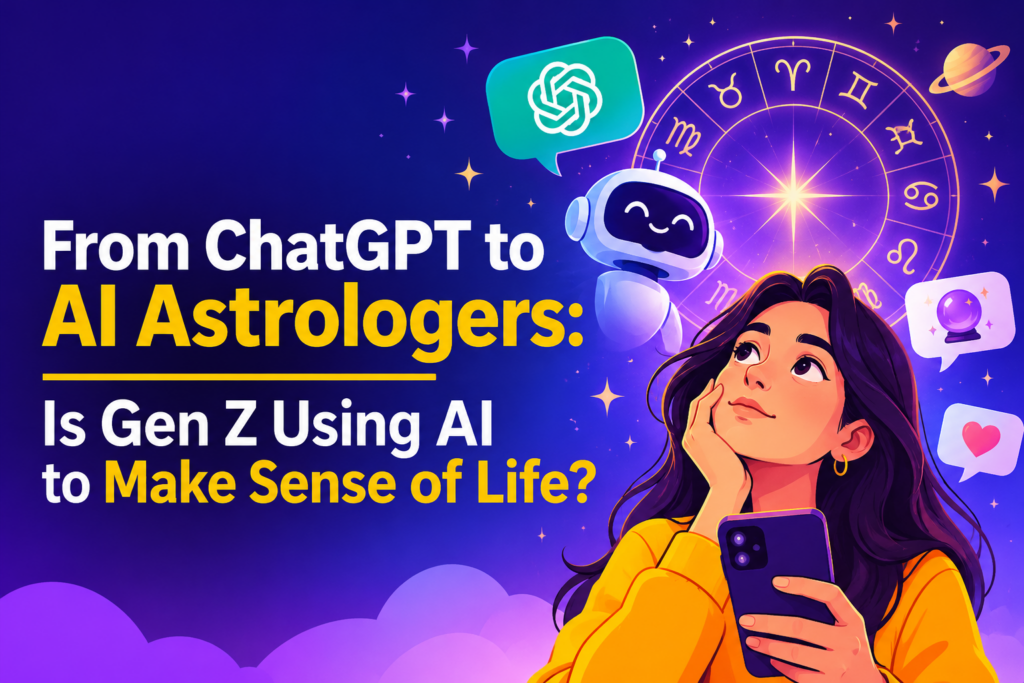
From ChatGPT conversations about relationships and career choices to dedicated AI astrologers offering predictions about marriage and the future, technology is gradually entering a space traditionally occupied by friends, family members, counsellors and astrologers.
The question is no longer simply whether Gen Z is adopting AI. It is whether young Indians are beginning to use it to make sense of their lives.
When AI becomes more than a productivity tool
The popularity of conversational AI has changed how people interact with technology. Instead of searching for information using specific keywords, users can now describe a problem, explain a situation and ask for suggestions in ordinary language.
This seemingly simple change has important implications.
Consider a college student who is uncertain about choosing between two career paths. Traditionally, the student might speak to a professor, consult a senior, ask friends or discuss the decision with family. Now, there is another option: open an AI assistant and describe the situation.
The student can ask follow-up questions, challenge the suggestions and explore different possibilities without worrying about taking up someone’s time.
Similarly, someone experiencing difficulties in a relationship might use AI to understand a disagreement, draft a difficult message or consider whether a particular behaviour is concerning.
The attraction is not necessarily that AI has all the answers. It is that it is accessible, conversational and available whenever someone wants to talk.
For a generation accustomed to interacting with digital platforms throughout the day, this can make AI feel like a natural extension of everyday life.
There is also an important psychological distinction. Asking a search engine about relationship problems is different from describing a personal situation to an AI assistant and receiving a response that appears to understand the context.
The interaction can feel less like searching for information and more like having a conversation.
Marriage, career and the growing popularity of AI astrologers
An interesting indication of this behaviour emerged in a report published by Zee Business in November 2026, citing data from AstroSage AI.
According to the report, its AI astrologer, Rahasya Veda, received nearly 14 crore questions in approximately 11 months. Users aged 14–29 accounted for around 43% of the questions.
The most frequently discussed subject was marriage, accounting for 27.18% of queries. Career followed at 25.17%, while love and relationships represented another 24.44%.
Studies accounted for 8.12%.
The numbers offer an interesting glimpse into the kinds of questions people are asking AI-powered astrology platforms.
Marriage-related queries were marginally ahead of career questions, while love and relationships together with marriage accounted for more than half of the reported queries.
However, these figures need to be interpreted carefully. They represent questions submitted to one astrology platform, not a representative survey of Indian Gen Z. Nor do they establish how many unique individuals were involved. A single user could have asked multiple questions.
Nevertheless, the findings raise an interesting question: why are young people increasingly comfortable turning to technology for answers about subjects that have traditionally been deeply personal?
Part of the answer may lie in accessibility.
A traditional astrological consultation may involve finding an astrologer, arranging a meeting and sharing personal information. An AI astrologer can offer an immediate interaction through a smartphone.
Users can ask questions about marriage, compatibility, career prospects or future events without having to explain themselves to another person.
For some, this might be an expression of genuine belief in astrology. For others, it could simply be curiosity, entertainment or a way of finding reassurance during uncertain moments.
The distinction matters. Using an AI astrologer does not automatically mean someone believes every prediction it generates.
The appeal of having someone—or something—to talk to
One of the more interesting aspects of AI adoption is the possibility that people are using it not just to obtain information but also to organise their thoughts.
Young people today navigate several competing expectations.
They are encouraged to build successful careers, become financially independent, maintain relationships, develop meaningful social connections and make decisions about their futures. At the same time, they encounter constant comparisons through social media, where the professional and personal milestones of others are visible every day.
A former classmate gets a job at a multinational company. A friend announces an engagement. Someone else moves abroad, starts a business or appears to have figured out their life.
Even when these comparisons are not deliberate, they can create a sense that everyone is moving forward while one’s own decisions remain uncertain.
In such circumstances, an AI assistant can become an accessible place to articulate concerns.
Someone unsure about their career might ask whether they should pursue higher education or accept their first job. Another person might describe a relationship disagreement and ask how to approach the conversation. A student worried about the future might simply want to explore different possibilities.
AI can help break down complicated situations, present alternative perspectives and suggest questions worth considering.
There is, however, a difference between helping someone think through a problem and actually understanding their emotional experience.
AI systems generate responses based on patterns in information and the context of a conversation. Their ability to produce empathetic language should not be confused with human understanding, professional counselling or genuine emotional attachment.
That distinction becomes particularly important when conversations involve serious mental health concerns, abuse or major life decisions.
From relationship advice to career guidance: AI is entering personal decision-making
The growing use of AI for personal questions is not limited to astrology.
Career guidance is an obvious example.
For students preparing to enter the workforce, choosing a career can feel like a high-stakes decision. The rapid emergence of new technologies, uncertainty about future job opportunities and changing skill requirements make it difficult to know which direction to pursue.
AI assistants can help students explore career options, compare educational pathways, understand job descriptions and identify skills they might need to develop.
For someone preparing for their first interview, AI can simulate interview questions. For someone considering a career change, it can help compare different possibilities.
Relationship advice represents another area of experimentation.
A user might ask AI to interpret a confusing message, help communicate feelings or suggest ways to handle disagreements. It can also provide a relatively private space to explore subjects that someone may hesitate to discuss with friends or family.
Then there are questions about emotional well-being.
Some users turn to conversational AI when they feel lonely, overwhelmed or uncertain. They may use it to write down their thoughts, understand a difficult experience or simply engage in a conversation when nobody else is available.
These applications are quite different from one another, but they share a common feature: people are using AI to navigate situations where they do not necessarily know what to do next.
The technology is becoming an additional source of guidance in everyday decision-making.
Is AI replacing friends, family members or traditional advisers?
It would be premature to suggest that AI is replacing human relationships or traditional sources of advice.
In many situations, young people will continue to rely on friends, parents, teachers, mentors and professionals. These relationships offer something an AI system cannot genuinely replicate: shared experiences, personal accountability, emotional understanding and knowledge of an individual’s circumstances beyond a text conversation.
However, AI may be changing the sequence in which people seek advice.
A student might first discuss a career decision with ChatGPT, develop a few questions and then speak to a professor. Someone experiencing relationship difficulties might use AI to organise their thoughts before discussing the issue with a friend.
An individual interested in astrology might first experiment with an AI astrologer before deciding whether to consult a traditional practitioner.
In this sense, AI does not necessarily have to replace existing relationships to become influential. It only needs to become an additional step in the decision-making process.
And because it is available around the clock, that step can happen at almost any time.
This creates an interesting challenge for parents, educators and employers. Young people may increasingly arrive at conversations having already explored a subject with an AI assistant. Understanding how to evaluate that information and distinguish useful suggestions from unreliable responses will become an important skill.
The risks of allowing AI to influence personal decisions
The growing use of AI for personal guidance also raises questions that deserve attention.
The first is accuracy.
An AI assistant can produce a confident-sounding response even when the information behind it is incomplete or incorrect. In career guidance, this could lead someone towards unsuitable choices. In relationships, it could encourage conclusions based on an incomplete account of a situation.
The second concern is dependence.
If someone begins turning to AI for reassurance every time they face uncertainty, there is a possibility that the technology could become a substitute for developing their own decision-making abilities.
There is also the question of privacy. Conversations about relationships, finances, family circumstances and personal anxieties can contain sensitive information. Users should understand how different platforms collect, retain and use the information they share.
AI astrology introduces an additional concern: the difference between predictions and evidence-based guidance.
An AI astrologer may generate an elaborate explanation about someone’s future marriage or career. But the sophistication of the response does not establish that the prediction is accurate.
Young users need to recognise that an algorithm cannot reliably determine when they will get married, whether a relationship will succeed or how their professional future will unfold.
There is nothing inherently wrong with exploring astrology as a cultural practice, personal interest or form of entertainment. The concern arises when generated predictions begin influencing important decisions without independent consideration.
The ability to use AI thoughtfully may therefore become just as important as the ability to use it effectively.
What this means for brands and businesses engaging with Gen Z
There is another dimension to this shift that brands should pay attention to.
For years, businesses have largely approached Gen Z through digital platforms, influencers, entertainment and personalised content. Understanding what young people watch, follow, buy and share has been central to marketing strategies.
But if AI is increasingly becoming a destination for personal questions, it could also influence how young consumers discover products, evaluate services and make decisions.
Imagine someone asking an AI assistant which career course would be useful, which financial product might suit a first-time investor or which skincare routine could address a particular concern.
The response may introduce brands, products or services that the individual had not previously considered.
This creates a new relationship between AI, information and consumer decision-making.
For brands, the opportunity is not to position themselves as the answer to every personal concern. It is to ensure that the information available about their products and services is accurate, useful and credible.
There is also an important responsibility here. Young consumers exploring sensitive subjects should not be targeted through their personal anxieties or encouraged to make decisions based on exaggerated promises.
As AI becomes more involved in discovery and decision-making, transparency and trust will matter even more.
The bigger question is not whether Gen Z trusts AI
The emergence of AI astrologers and the growing use of conversational AI for personal questions point towards a larger cultural development.
Young people are experimenting with a technology that can respond to almost any question, at almost any time. They are using it to learn, work, create, explore possibilities and sometimes seek reassurance about things they cannot easily control.
But perhaps the most interesting question is not whether Gen Z trusts AI completely.
It is why young people feel the need to ask these questions in the first place.
Questions about marriage, relationships, careers and the future have existed across generations. What is changing is the place where some of these questions are being asked.
A generation that grew up with smartphones and social media is now discovering conversational technology as another space for exploring uncertainty.
AI may not know whether someone will find love, build a successful career or achieve the future they imagine. It cannot guarantee that difficult decisions will have happy outcomes.
But it can offer a conversation, suggest possibilities and help someone organise thoughts that might otherwise remain unspoken.
That may be enough to make it an increasingly important part of everyday life.
For TheYouthTalks, the larger story is worth exploring beyond the popularity of AI astrologers. It is about a generation navigating an uncertain world and developing a new relationship with technology—not just as a tool to get things done, but as a place to ask questions about who they are, what they want and where their lives might be heading.
And perhaps that is one of the more consequential changes AI is bringing about: it is moving from answering questions about the world to becoming part of how young people think about their own lives.
Source note: This article uses the AstroSage AI figures as an illustrative example of AI astrology adoption. The figures are platform-specific and should not be interpreted as representative of all Indian Gen Z users. AI-generated advice and astrological predictions should not be treated as substitutes for qualified professional guidance or independent decision-making.