Global creators came to India looking for stories. In the process, they may be changing how a new generation of Indians sees, experiences and travels across its own country.
There is something quietly fascinating happening on India’s travel internet.
Open YouTube, Instagram or any of the increasingly fragmented corners of the creator economy and you will find an unmistakable pattern. A British vlogger is travelling through Rajasthan. An American creator is eating his way through Delhi. An Australian is wandering through Mumbai. A European backpacker is discovering the Northeast. A Canadian food creator is documenting India’s regional cuisines. Some arrive for a few weeks. Others keep coming back.
At first glance, this looks like a familiar tourism story.
India is an extraordinary destination. It is visually spectacular, culturally diverse and almost impossibly varied. For a foreign creator, it offers an abundance of stories: food, trains, religion, architecture, wildlife, spirituality, fashion, history, festivals and, perhaps most importantly, people.
But there is another audience watching all of this.
Indians.
And increasingly, India’s young Indians.
That changes the story.
Because the foreign creator isn’t simply introducing India to an international audience. They may also be introducing India to Indians who have never experienced large parts of their own country.
A young person in Delhi watches an American creator travel through Meghalaya. Someone in Mumbai watches a British vlogger explore Assam. A college student in Bengaluru discovers a remote Himalayan town because a European backpacker spent three days there.
The viewer’s reaction isn’t necessarily, “That’s interesting.”
It can be:
“Why haven’t I been there?”
That question may be at the heart of a new kind of Indian travel culture.
Call it the Foreign Creator Effect.
India has become a destination for the world’s storytellers
India has never lacked visitors.
What has changed is what happens after they arrive.
The traditional foreign tourist travelled, took photographs and went home. The modern creator travels with a camera, an audience, an algorithm and an expectation that the journey itself will become a piece of media.
That distinction is enormous.
A creator doesn’t simply visit Jaipur.
They create a Jaipur video.
They don’t merely eat in Delhi.
They make a street-food episode.
They don’t simply travel on an Indian train.
The train journey becomes the story.
Every experience can now be converted into content, and every piece of content can travel far beyond the physical destination.
This makes India particularly attractive to creators.
There is an almost endless supply of visual and narrative material.
The country can be beautiful, chaotic, funny, emotional, overwhelming, deeply traditional and surprisingly modern — sometimes within the same hour.
For a storyteller, that is gold.
And the audience knows it.
The foreign creator is no longer just a tourist
This is where the creator economy begins to overlap with tourism.
For decades, tourism marketing was largely built around a destination telling people why they should visit.
A campaign might show a spectacular landscape.
A brochure might describe an experience.
A hotel might show a beautiful room.
A tourism board might produce a polished film.
Creators have changed the equation.
Instead of saying:
“India is incredible.”
the creator says:
“I came to India. This is what happened.”
The distinction is subtle, but enormously important.
One is advertising.
The other feels like discovery.
A viewer isn’t simply being told that something is worth seeing. They are watching somebody experience it in real time.
They see the confusion.
The excitement.
The food.
The people.
The mistakes.
The unexpected moments.
The things that don’t make it into a tourism brochure.
That is precisely what makes creator-led travel so powerful.
The creator becomes the bridge between the destination and the traveller.
And then something unexpected happens: Indians start watching
The most interesting part of this phenomenon isn’t necessarily the foreign audience.
It is the Indian audience.
India’s Gen Z is growing up in an environment where travel inspiration is overwhelmingly visual.
A destination is increasingly discovered through a Reel, a Short, a vlog or a creator recommendation rather than through a traditional travel guide.
And foreign creators occupy an unusual position in this ecosystem.
They are simultaneously outsiders and observers.
When an Indian creator visits India, the viewer may already have a frame of reference.
When a foreign creator visits India, the experience is different.
Everything becomes new.
A roadside meal becomes an adventure.
A local train becomes an experience.
A crowded market becomes a story.
A small town becomes a destination.
A regional dish becomes something to investigate.
The foreigner’s curiosity forces the Indian viewer to look at something familiar through unfamiliar eyes.
And sometimes that is enough to make the familiar interesting again.
Why does seeing a foreigner experience India feel different?
There is a strange psychology to external validation.
Indians have lived with the contradictions of India for generations.
The chaos is normal.
The food is normal.
The railway station is normal.
The wedding is normal.
The monsoon is normal.
The neighbourhood market is normal.
But to someone visiting for the first time, none of it is normal.
They notice everything.
And when they express amazement, an Indian viewer may suddenly notice the same thing.
A foreign creator standing in front of a centuries-old monument may make a young Indian think:
“I’ve lived here my whole life and I’ve never actually gone there.”
A foreign creator eating a regional Indian dish may make someone think:
“I’ve never tried that.”
A foreigner travelling through a state thousands of kilometres away may make someone realise that they know surprisingly little about the country they live in.
That is the paradox.
Sometimes Indians need outsiders to remind them how extraordinary India is.
The creator may be redrawing India’s travel map
For a long time, India’s domestic tourism map had a relatively familiar shape.
Goa.
Manali.
Shimla.
Jaipur.
Udaipur.
Kerala.
Rishikesh.
Mumbai.
Delhi.
Kashmir.
These destinations will remain popular. But social media is changing what can become a destination.
A place doesn’t necessarily need to have been traditionally marketed as a tourist hotspot anymore.
It needs to be discoverable.
A creator can take a relatively obscure destination and give it a narrative.
Suddenly, people aren’t searching for the location because a tourism board told them to.
They’re searching because someone they watched spent ten minutes there.
This is particularly powerful for India’s Northeast, smaller Himalayan destinations and lesser-known cultural regions.
A place can move from:
“Where is that?”
to:
“I want to go there.”
without ever passing through the traditional machinery of tourism advertising.
The new Indian traveller wants experiences, not just destinations
This matters because Gen Z is not necessarily travelling in the same way previous generations did.
The traditional holiday often revolved around a destination.
You went to Goa.
You went to Kerala.
You went to Europe.
You booked the hotel, visited the major attractions, took photographs and came home.
For younger travellers, the experience is increasingly the product.
It could be a food trail.
A trek.
A music festival.
A homestay.
A road trip.
A local market.
A spiritual retreat.
A train journey.
A village.
A particular restaurant.
A hidden beach.
The destination becomes a container for experiences.
And creators are exceptionally good at packaging experiences.
A 20-minute YouTube video can effectively become a travel guide, itinerary, review, entertainment programme and recommendation engine all at once.
The viewer doesn’t simply learn where to go.
They learn how to experience the place.
That is a profound change.
The rise of the three-day adventure
For India’s young urban population, travel is also becoming more fragmented.
A holiday doesn’t necessarily have to mean two weeks away.
It could mean a long weekend.
A spontaneous trip with friends.
A short solo journey.
A quick escape from a city.
Three days in a new state.
Two nights in a homestay.
A road trip that starts on Friday evening.
This is where creator content becomes even more influential.
A young person may not need to be convinced to take a major holiday.
They only need to see an interesting possibility.
“You can fly here on Friday, stay here, eat this, see this and return Sunday.”
Suddenly, an unknown destination becomes accessible.
The creator has transformed aspiration into an itinerary.
Foreign creators may be accidental travel scouts for Gen Z
This is perhaps the most interesting consequence of the entire phenomenon.
A foreign creator may not come to India with Indian Gen Z in mind.
They might be looking for a new story.
A new country.
A new food culture.
A new adventure.
But their exploration creates a catalogue of possibilities for Indian viewers.
They go somewhere Indians haven’t considered.
They document it.
Indian audiences watch.
And a destination that was previously outside the mainstream travel conversation begins to acquire cultural currency.
The creator has effectively become an accidental scout.
They find places.
They demonstrate experiences.
They create the first layer of social proof.
And then Indian travellers take over.
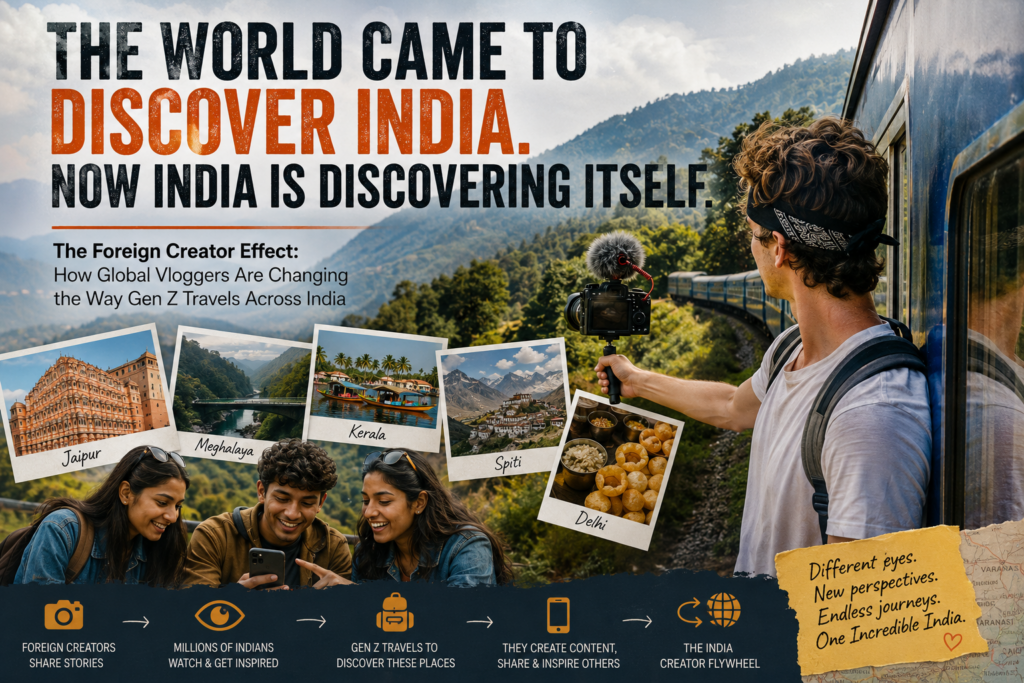
The India Creator Flywheel
This is where the phenomenon starts becoming bigger than individual creators.
Imagine the cycle.
A foreign creator discovers an unusual Indian destination.
They film it.
The video reaches millions of people.
Among those viewers are Indian Gen Z consumers.
Some become curious.
A few decide to visit.
They create their own Instagram posts and YouTube videos.
Their friends see them.
Indian creators notice that the destination is generating interest.
Hotels and homestays start receiving more enquiries.
Restaurants and local businesses benefit.
More creators arrive.
The destination gets more content.
More people discover it.
And the cycle repeats.
That is the India Creator Flywheel.
It is not necessarily orchestrated by one organisation.
There doesn’t have to be a mastermind behind it.
In fact, its power may come from the opposite.
It is decentralised.
Creators, audiences, businesses, tourism boards and platforms are all responding to one another.
The algorithm amplifies what people already find interesting.
And travel becomes increasingly shaped by that feedback loop.
From tourism marketing to creator tourism
We may therefore be entering a new era of tourism.
Traditional tourism marketing says:
“Come to India.”
Creator tourism says:
“Come with me to India.”
That is psychologically different.
A tourism advertisement shows you the finished picture.
A creator shows you the journey.
A hotel campaign shows you the room.
A creator shows you what happened after they checked in.
A tourism brochure tells you what to eat.
A food creator actually eats it.
A destination campaign tells you that the landscape is beautiful.
A vlogger shows you what it feels like to stand there.
The creator provides something traditional advertising has always struggled to manufacture:
context.
The foreign creator economy is also creating a local ecosystem
The creator is the most visible person in the picture.
But there is a large ecosystem behind them.
Local guides.
Fixers.
Editors.
Drivers.
Photographers.
Videographers.
Hotels.
Homestays.
Restaurants.
Tour operators.
Tourism officials.
PR agencies.
Local creators.
Brand managers.
Airlines.
Experience providers.
The foreign creator arrives with the audience.
India provides the setting and the story.
The local ecosystem helps convert that story into content.
The content travels.
And then the economic value begins moving back into the destination.
This is why the foreign creator phenomenon should not be viewed purely as an influencer trend.
It is increasingly part of a larger media-tourism economy.
And India has something most destinations don’t
Scale.
India isn’t one destination.
It is hundreds of destinations sitting inside one country.
One creator can spend months travelling and still barely scratch the surface.
The geography changes.
The languages change.
The food changes.
The architecture changes.
The climate changes.
The cultural context changes.
Even the meaning of travel changes from one state to another.
For creators, that means India isn’t a single content opportunity.
It is a potentially endless content universe.
And for Gen Z, that means the country can keep revealing new places.
You don’t necessarily have to travel abroad to discover something unfamiliar.
You may only have to cross a state border.
There is also a deeper cultural consequence
India has traditionally exported its culture through cinema, music, cricket, food, yoga, spirituality and fashion.
The creator economy introduces another form of cultural exchange.
Now India is being interpreted by outsiders in real time.
A foreign creator becomes a narrator.
They take their audience into India.
But something else happens simultaneously.
Indians watch the narration.
They see how someone from another country interprets their culture.
They see what surprises them.
They see what they admire.
They see what confuses them.
They see what they photograph.
And they may begin to see their own country differently.
This is a subtle form of cultural exchange.
It isn’t official.
It isn’t always planned.
And it isn’t necessarily always accurate.
But it is powerful.
The danger of the “foreigner discovers India” genre
There is, however, a darker side to the phenomenon.
The algorithm rewards extremes.
Surprise.
Shock.
Reaction.
Novelty.
And India provides an almost unlimited supply of material that can be packaged that way.
The result can sometimes be a very narrow version of India.
The chaotic India.
The unbelievably spicy India.
The crowded India.
The spiritual India.
The poverty-stricken India.
The spectacular India.
The “I can’t believe this exists” India.
These videos can be entertaining and sometimes genuinely insightful.
But they can also reduce a complex country to a collection of algorithm-friendly moments.
That matters because the creator isn’t merely showing India to foreigners anymore.
They are also showing India to Indians.
And young Indians are consuming these narratives alongside everything else they see online.
The question therefore becomes:
What version of India is Gen Z learning to travel through?
Perhaps the most interesting part is what happens next
A foreign creator arrives.
They discover a place.
They film it.
Millions watch.
But eventually the creator leaves.
The camera moves elsewhere.
The story should end.
Except it doesn’t.
An Indian viewer may save the video.
Send it to friends.
Add the destination to a wishlist.
Book a trip months later.
Post photographs.
Make a Reel.
Tag the location.
And suddenly another creator sees it.
The destination has acquired a life of its own.
This is where the foreign creator stops being the protagonist.
The Indian traveller becomes the next storyteller.
And that may be the real significance of this phenomenon.
India is beginning to discover itself through a global lens
There is something beautifully ironic about the whole cycle.
Foreign creators are coming to India because they believe India has stories worth telling.
Indian Gen Z is watching those stories because they are curious about how outsiders experience their country.
And then, increasingly, young Indians are going out to experience those places themselves.
They become travellers.
Then photographers.
Then vloggers.
Then storytellers.
The audience becomes the creator.
The viewer becomes the traveller.
The destination becomes the content.
And the content creates the next traveller.
That is the flywheel.
For India’s tourism industry, this could eventually mean something far bigger than influencer marketing.
For creators, India could become one of the world’s richest content environments.
For local businesses, a single viral video can turn an unknown experience into a commercial opportunity.
And for Gen Z, perhaps the biggest consequence is much more personal.
They are being given permission to look at India differently.
Not as the country they grew up in.
Not as the place their parents travelled to.
Not as a collection of textbook chapters and tourist brochures.
But as an enormous, unfinished map of experiences waiting to be discovered.
The world came to discover India. India may be discovering itself in return.
The next time a foreign vlogger walks through a small Indian town and says, “I can’t believe more people don’t know about this place,” it may be tempting to see it simply as another piece of travel content.
But somewhere in Delhi, Mumbai, Bengaluru, Hyderabad, Pune or a college campus thousands of kilometres away, a young Indian may be watching.
They may pause.
They may search the location.
They may send the video to a friend.
And six months later, they may be standing in that same place.
Only this time, they won’t be watching it on a screen.
They’ll be there.
Taking their own photograph.
Making their own Reel.
Telling their own story.
And perhaps that is the most interesting thing happening in Indian travel today.
Foreign creators may be bringing the world’s eyes to India. But in the process, they may be teaching India’s youngest generation to open their own eyes to the country around them.
The foreign creator effect, ultimately, isn’t about foreigners.
It is about discovery.
And the next great map of India may not be drawn by tourism boards at all.
It may be drawn, one video at a time, by the world’s creators — and the millions of young Indians watching them.