

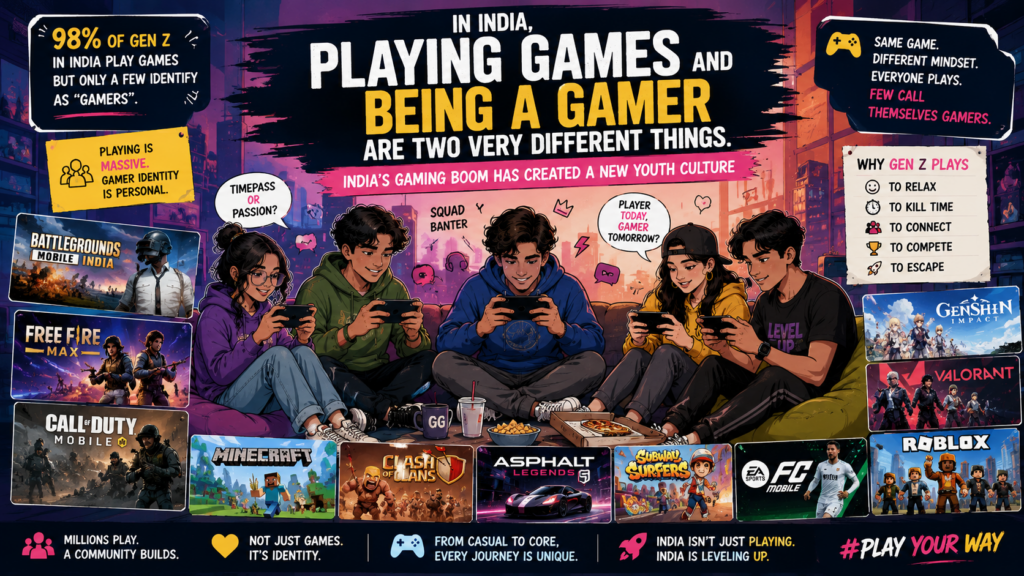
India’s Gaming Boom Has Created a New Youth Culture
Walk into any college canteen, metro coach, or hostel common room in urban India, and chances are you’ll spot someone gaming. It might be a quick round of Battlegrounds Mobile India between lectures, a casual session of Ludo King with family, or late-night squad matches on Free Fire MAX with friends.
Gaming is no longer a niche in India. It is mainstream.
According to a report by Lumikai and Google India, India’s gaming community crossed 590 million gamers in 2024, making it one of the largest gaming markets globally. That number alone tells a compelling story. Yet, beneath the scale lies an interesting cultural nuance: not everyone who plays games considers themselves a gamer.
And that distinction matters far more than most people realize.
Playing Games vs Being a Gamer
At first glance, the difference may seem semantic. If someone spends hours playing games every week, aren’t they automatically a gamer?
Not necessarily.
I’ve personally seen this play out in conversations with students. A 20-year-old engineering student once told me, “I play BGMI almost every day, but I’m not really a gamer.” That statement sounds contradictory, but in India, it is surprisingly common.
Why?
Because being a gamer is not just about gameplay. It is about identity.
A gamer is usually more emotionally invested. They follow esports tournaments, watch streamers, engage in communities, discuss device specs, and often treat gaming as part of self-expression. In contrast, many young Indians play games casually—as a form of entertainment, stress relief, or social bonding—without attaching identity to it.
The difference lies not in the number of hours alone, but in the depth of involvement.
Why Many Young Indians Avoid the “Gamer” Label
Unlike some Western markets, where gaming identity has become normalized, India still carries social baggage around gaming.
For many families, gaming is often associated with:
- Distraction
- Addiction
- Reduced productivity
- Timepass
Phrases like “Gaming se kya hoga?” or “Focus on your studies” are still common in Indian households.
This creates hesitation. Even dedicated players sometimes avoid calling themselves gamers because the label feels socially loaded.
However, that perception is changing.
The rise of Indian creators like Naman Mathur and Tanmay Singh has helped transform gaming into something more aspirational. Gaming is increasingly seen as a skill-based ecosystem involving strategy, content creation, competition, and even careers.
Organizations such as NODWIN Gaming and Skyesports have also accelerated the growth of esports in India.
Still, gamer identity remains selective.
The Three Types of Gamers in India
Casual Players
This is the largest segment.
These users play for fun, boredom relief, or social connection. Their sessions are short, mobile-first, and low-commitment. They rarely spend heavily on in-game purchases or follow tournaments.
For them, gaming is simply one entertainment option among many.
They are players, not gamers.
Engaged Players
This is India’s fastest-growing segment.
These users play regularly, watch gaming creators on YouTube, follow updates, and may spend on battle passes or skins. Behaviorally, they resemble gamers.
Psychologically, however, many still see gaming as “just a hobby.”
This segment represents a huge opportunity for brands selling smartphones, wearables, audio devices, and lifestyle products.
Identity Gamers
This is the smallest yet most influential cohort.
For them, gaming is culture.
They invest in gaming laptops, mechanical keyboards, premium headsets, and high-refresh-rate devices. They actively participate in communities on Discord, follow esports, and care deeply about metrics like FPS, ping, GPU performance, and latency.
These users influence trends, purchases, and community conversations.
In many ways, they are the tastemakers of India’s gaming ecosystem.
Gaming Has Become India’s New Social Infrastructure
Perhaps the most fascinating shift is that gaming is no longer just about games.
It has become a social layer.
For millennials, social bonding often meant cricket in the park, café meetups, or hanging out in person. For Gen Z, social interaction increasingly happens inside digital spaces.
Squad lobbies are the new hangout spots.
Voice chats are today’s group calls.
Discord servers are digital addas.
Young people are not logging in only to play. They are logging in to connect, compete, and belong.
That emotional layer explains why gaming has become so sticky.
What Brands Need to Understand
This is where many brands get it wrong.
They assume that if young people play games, generic gaming ads will automatically work.
That approach misses the point.
The more important question is: Are we talking to players or to gamers?
Casual players respond well to rewards, offers, and utility-driven messaging.
Gamers respond to authenticity, community relevance, and cultural credibility.
The same campaign will not resonate with both.
The Future of Gaming in India
Gaming is becoming for Gen Z what cricket was for millennials—a shared cultural phenomenon.
But there is one major difference.
Cricket was largely passive viewing. Gaming is interactive, participative, and deeply personal.
That makes it more fragmented, but also far more powerful.
The biggest insight for brands, educators, and youth platforms is simple: gaming participation in India is massive, but gamer identity remains niche.
And that niche, despite its size, drives disproportionate influence.
In India, almost everyone may play games.
But only a few proudly say, with conviction:
“I am a gamer.”