

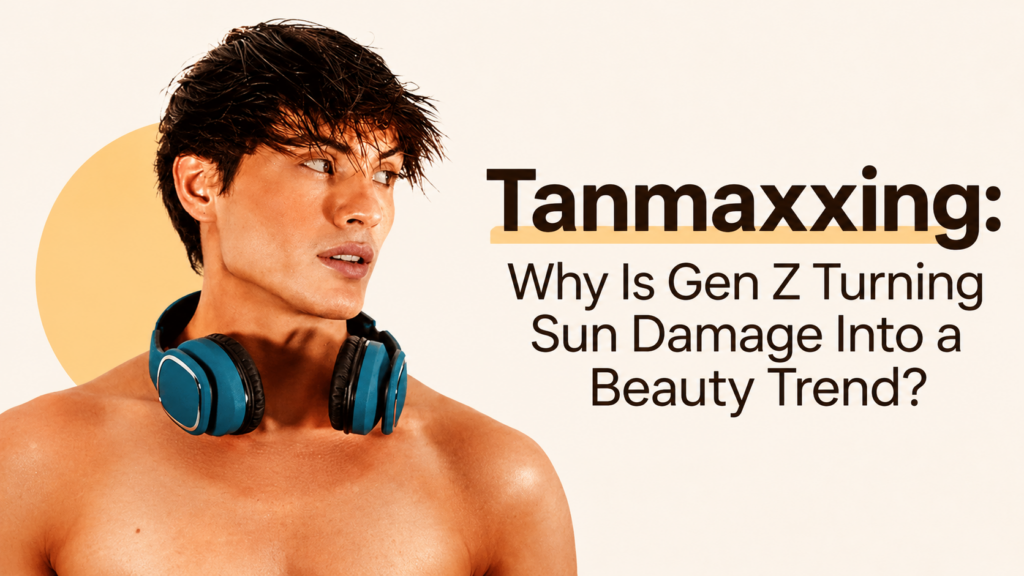
From Instagram tanning routines and bronzed-skin transformations to influencers promoting a deeper tan, a new internet trend is putting sun exposure back into the beauty conversation. But what exactly is tanmaxxing, why is it gaining attention in global markets, and what should India’s Gen Z know before following it?
A new word is finding its way into the internet’s expanding vocabulary of beauty and self-improvement: tanmaxxing.
The term sounds like another harmless addition to Gen Z’s online dictionary. But behind it is a beauty trend that has attracted the attention of dermatologists and public-health experts.
Borrowing from the language of looksmaxxing, the online culture of maximising one’s physical appearance, tanmaxxing refers to deliberately trying to achieve a deeper, darker tan. The objective is not simply to spend a day at the beach and return with a little colour. It is to actively pursue a bronzed complexion, sometimes through prolonged exposure to ultraviolet (UV) radiation, tanning oils, reduced sunscreen use and, in some cases, indoor tanning beds.
On Instagram, the trend can appear through tanning routines, before-and-after transformations, beach photographs, product recommendations and creators documenting their efforts to achieve a darker complexion. Some content even presents checking the UV index and choosing periods of stronger sunlight as part of a tanning routine.
What makes the trend concerning is that the very thing being celebrated as a beauty achievement is, from a medical perspective, a sign that the skin has experienced UV damage.
And as tanmaxxing enters conversations around Gen Z beauty culture, it raises a larger question: when did getting a tan become another appearance goal to optimise?
What exactly is tanmaxxing?
The word follows the now-familiar internet convention of adding ‘maxxing’ to a behaviour or characteristic to suggest taking it to the maximum.
Looksmaxxing, for example, describes efforts to improve one’s physical appearance through grooming, fitness, skincare and, in more extreme online spaces, potentially risky interventions. Tanmaxxing applies that optimisation mindset to skin colour.
The idea is straightforward: achieve a darker, more visibly bronzed complexion and treat the tan as an aesthetic outcome worth pursuing.
There is an important distinction between wanting a bronzed appearance and how someone tries to achieve it. A person may use cosmetic self-tanning products to change the appearance of their skin without deliberately exposing themselves to UV radiation. Tanmaxxing becomes a health concern when the pursuit involves intentionally increasing UV exposure, avoiding sun protection or using tanning beds.
Some online content goes further, promoting the idea that the best time to tan is when the UV index is high. Others showcase tanning oils and routines while giving little attention to the risks of repeated exposure.
A 2026 article published in Clinics in Dermatology, titled ‘Ethical Implications of Tanmaxxing Promotion on Social Media’, describes the emerging trend as the promotion of intentional UV exposure with minimal sun protection to achieve a darker tan. The authors raise concerns about how Instagram and other social-media platforms can amplify such content to younger audiences, sometimes presenting risky behaviour as an aspirational beauty routine.
The concern, therefore, is not simply that young people want tanned skin. It is that social-media content can make deliberately exposing the skin to damage appear normal, desirable or even clever.
Instagram and the return of tanning culture
Tanning itself is hardly new. In several Western markets, a bronzed complexion has been associated with holidays, leisure, outdoor lifestyles and beauty for decades.
The popularity of tanning beds and tanning salons rose during earlier decades, while spray tans and self-tanning products created alternatives for people seeking a darker appearance without spending hours in the sun.
What appears different about the current conversation is the way tanning is being packaged and distributed online.
Instagram has become an important space where beauty aesthetics are discovered, demonstrated and discussed. Through Reels, creator recommendations, hashtags and transformation videos, a particular look can quickly become part of a wider beauty conversation.
Tanning content fits naturally into this visual environment. A creator documenting a tanning transformation can present the process as a lifestyle routine, complete with products, photographs and progress updates. The bronzed look is often shown alongside beach holidays, swimwear, fitness and summer fashion.
A 2026 study published in JMIR Dermatology offers an interesting insight into the content circulating on Instagram. Researchers analysed 100 posts under the hashtag #tanning. Of these, 79 promoted tanning, while 21 took an anti-tanning position.
The study found that 63% of the posts presented tanned skin as a beauty standard. Only 11% included messaging advocating sun protection, while just 20% addressed the risks associated with tanning. The researchers also found that promotional posts were more likely to feature younger creators and shopping tags for tanning products.
The findings do not establish how many Instagram users are tanmaxxing. But they do reveal how tanning can be presented in an online environment where appearance, product discovery and creator influence intersect.
This is an important distinction. A trend does not need to be followed by millions of people to influence the beauty conversation. Repeated exposure to similar images and routines can make a particular appearance seem more desirable, more normal and more achievable.
Is the trend growing across global markets?
The tanmaxxing conversation has received attention in the United States, Canada and the United Kingdom, with dermatologists and beauty-industry publications examining the renewed interest in tanning among younger consumers.
In North America, media coverage has highlighted creators documenting their tanning routines, showing off tan lines and discussing ways to achieve a darker complexion. Some content has also revived older tanning practices, including the use of indoor tanning beds.
Canada offers a particularly interesting indicator of the broader tanning conversation.
In May 2026, the Canadian Dermatology Association released findings from an Ipsos survey examining Gen Z attitudes towards tanning and sun protection.
According to the survey, 39% of Gen Z Canadians said they had intentionally tanned in the previous year. Among those who reported tanning, 72% said they did so outdoors. The survey also found that 68% of Gen Z respondents believed intentional tanning was common among their peers.
Appearance played a role in the decision. Among those who intentionally tanned, 45% said it made them feel more confident, while 37% said they believed they looked better in photographs.
Perhaps the most revealing finding was the disconnect between awareness and behaviour. While 79% of respondents expressed concern about skin cancer and 63% knew that tanning was a risk, 39% still reported intentionally tanning.
These figures relate to intentional tanning, not tanmaxxing specifically. But they suggest that the desire for a bronzed appearance continues to influence young consumers, even in markets where sun-safety messaging is well established.
The broader lesson is that awareness of health risks does not always translate into a change in behaviour. When appearance, confidence and peer influence become part of the equation, health warnings can lose some of their persuasive power.
In the United Kingdom, the beauty industry has also been examining the return of tanning culture, including the promotion of tanning products and concerns about misleading claims around UV exposure.
The common thread across these markets is the intersection of beauty aspirations, social-media influence and the commercial promotion of tanning products.
Tanmaxxing may be a relatively new word, but it is not necessarily a completely new desire. Tanning has long been part of beauty culture in some countries. The internet has given that desire a new identity, a language of optimisation and a way to circulate through creator communities.
Why is a tan considered desirable in some parts of the world?
Beauty standards are not universal. They change across countries, communities, generations and even social groups.
In parts of Europe and North America, a bronzed complexion has historically been associated with holidays, outdoor recreation and a particular idea of a healthy, active lifestyle. The appeal is also connected to fashion, celebrity culture and the visual language of summer.
Social media has made these aesthetics easier to share and reproduce. A tan can be presented alongside beach holidays, fitness routines, swimwear, summer fashion and lifestyle content. In that context, it can become more than a skin tone: it becomes part of a broader image of how someone wants to look and be perceived.
This is where tanmaxxing connects with the larger looksmaxxing conversation.
The internet increasingly gives names to specific appearance goals. Instead of simply wanting to look good, users encounter a growing vocabulary of ways to improve, enhance or optimise individual aspects of their appearance.
The potential problem is that these goals can become increasingly prescriptive. A particular complexion, body shape or facial feature is elevated as desirable, and the effort to achieve it can sometimes take precedence over the health implications.
The Indian contradiction: A very different relationship with skin colour
For Indian Gen Z, tanmaxxing presents a particularly interesting cultural contradiction.
India has a long and complicated relationship with skin colour. Fairness has historically been privileged in parts of the beauty and matrimonial markets, while fairness-focused advertising and products have faced sustained criticism for reinforcing colourist assumptions.
At the same time, global fashion, travel, fitness and beauty culture often celebrate bronzed skin as an aspirational look.
These are two very different beauty narratives existing in the same digital environment.
An Indian young person scrolling through Instagram may encounter content that celebrates a darker, sun-kissed complexion alongside beauty messaging that continues to privilege lighter skin. The result is not necessarily a single emerging beauty standard, but a more complicated landscape in which different aesthetics compete for attention.
It would be premature to suggest that tanmaxxing has become a significant trend among Indian Gen Z. There is not yet sufficient India-specific evidence to make that claim.
But the conversation matters because Indian audiences are exposed to international beauty content, influencer recommendations and skincare trends. A practice that gains visibility in one market can quickly become part of the online vocabulary in another, even if local adoption remains limited.
There is also a practical difference that Indian consumers should consider. Sun exposure is a regular part of life in many Indian cities, and high UV levels can occur even when the weather does not feel particularly hot. Deliberately increasing UV exposure to achieve a cosmetic result is not a harmless experiment.
What should Indian Gen Z know before chasing a tan?
The most important thing to understand is that a UV-induced tan is not a sign of healthy skin.
According to the World Health Organization (WHO), tanning is the skin’s response to ultraviolet radiation. The increased production or darkening of melanin is part of the body’s defence mechanism against further damage. A tan may be cosmetically desirable to some people, but it does not mean the skin has become healthier.
There are several misconceptions worth addressing.
1. A tan is not a protective base layer
One claim sometimes repeated in tanning communities is that developing a base tan protects the skin from future sun damage.
The WHO explains that a UV-induced tan provides only limited protection, equivalent to a sun protection factor of approximately 2 to 4. It is not a substitute for sunscreen, protective clothing or shade, and it does not prevent long-term UV damage.
2. Darker skin does not mean immunity from UV damage
Melanin offers some natural protection, but it does not make anyone immune to the effects of ultraviolet radiation.
People with darker skin can still experience sun damage and develop skin cancer. The WHO specifically notes that people with darker skin tones are also susceptible to skin cancers, even though the risk of sunburn and certain skin cancers is higher among people with lighter skin.
3. Sunburn is not the only warning sign
A common misconception is that if the skin does not burn, it has not been damaged.
But UV exposure can cause harm even without visible sunburn. The WHO identifies ultraviolet radiation as a major cause of skin damage, premature ageing and skin cancers. The effects can accumulate over time.
4. Tanning beds are not a safer shortcut
Indoor tanning beds expose the skin to artificial UV radiation. The WHO notes a clear association between sunbed use and skin cancer and recommends avoiding them.
5. Be cautious about tanning pills, injections and nasal sprays
Some online communities promote products intended to darken the skin, including substances such as Melanotan II. These are not harmless skincare shortcuts. Young consumers should not experiment with unapproved tanning drugs, injections or nasal sprays based on influencer recommendations.
For anyone seeking a bronzed appearance, cosmetic self-tanning products are different from UV tanning because they do not rely on deliberately damaging the skin through ultraviolet exposure. However, they do not provide sun protection. Sunscreen and other protective measures remain necessary.
The WHO recommends a combination of practical precautions: seeking shade when UV radiation is strongest, wearing protective clothing and using broad-spectrum sunscreen of at least SPF 30 on exposed areas. Sunscreen should not be treated as a way to extend time spent in the sun.
The bigger question: Is every beauty trend becoming an optimisation project?
Tanmaxxing may be a relatively new word, but the behaviour it describes sits within a much larger development in online beauty culture.
From looksmaxxing to skin cycling, from facial aesthetics to body optimisation, social media has created an environment where almost every aspect of appearance can become a subject of advice, comparison and improvement.
There is nothing inherently wrong with experimenting with fashion, make-up, skincare or personal style. The concern begins when an aesthetic preference is presented as something worth risking one’s health to achieve.
For brands, creators and the beauty industry, tanmaxxing also raises questions about responsibility. When content promotes a particular appearance while minimising the risks of achieving it, the line between inspiration and misinformation becomes difficult to ignore.
For Indian Gen Z, the lesson is not that a bronzed complexion is undesirable or that every international beauty trend should be rejected. It is that young consumers should understand the difference between choosing an aesthetic and following a potentially harmful method to achieve it.
A beauty trend can change in a few weeks. The consequences of repeated UV damage can last much longer.
Perhaps that is the most important thing to remember about tanmaxxing: you can choose the look you like without having to damage your skin to get there.