
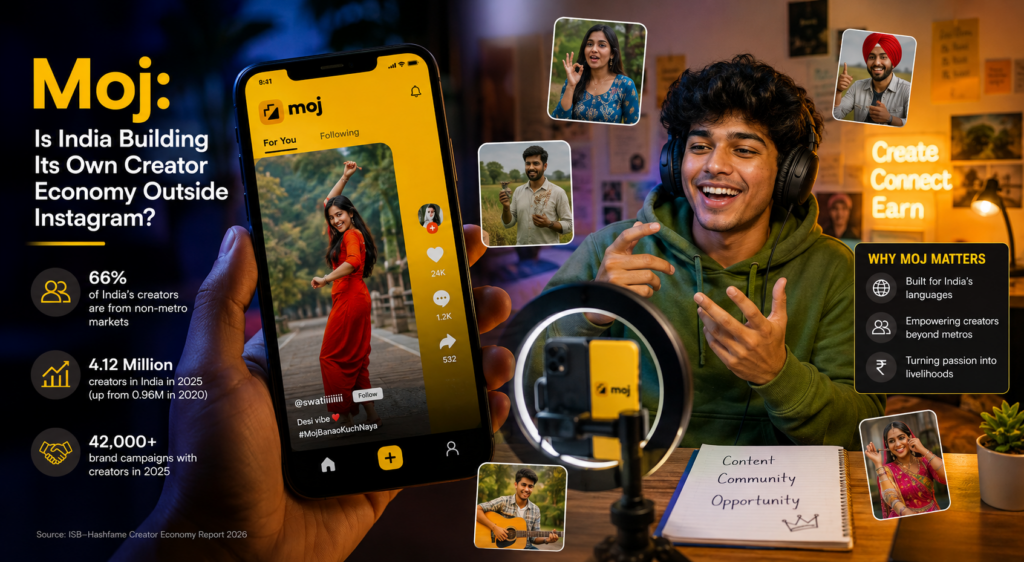
Five years after emerging in the shadow of TikTok’s ban, Moj is trying to become something more ambitious than a short-video platform — a creator ecosystem built around India’s languages, smaller cities and a different definition of influence.
There is an India on the internet that is remarkably easy to miss.
It does not always speak English. It does not necessarily live in Mumbai, Delhi or Bengaluru. Its creators may not have millions of followers, and their names may never appear on the guest lists of the biggest influencer events.
Yet people watch them.
They watch them in Hindi, Marathi, Punjabi, Bengali, Tamil, Telugu, Bhojpuri and dozens of other linguistic and cultural contexts. They follow creators who speak the way they speak, understand the jokes they understand and reference the places, festivals, aspirations and everyday experiences that feel familiar.
This is the India that Moj has spent the last few years trying to capture.
And in 2026, the interesting question is no longer whether Moj can compete with Instagram.
The more interesting question is whether it is building a different kind of creator economy altogether.
From a TikTok moment to something more permanent
Moj’s origin story is almost tailor-made for a technology case study.
In July 2020, following India’s ban on TikTok, a wave of Indian short-video platforms rushed into the space. Moj was among the most successful.
The company has previously said that its first version of Moj was built in roughly 30 hours following the ban. It subsequently grew rapidly, at one point reporting more than 160 million monthly active users and a creator community of more than 50 million across 15 Indian languages.
Those numbers are historical rather than a current 2026 user count, and Moj does not appear to publicly report an equivalent current standalone MAU figure.
But the early scale proved something important.
Moj was not simply filling a hole left by TikTok.
It was demonstrating that India had a substantial appetite for short-form entertainment rooted in Indian languages and Indian culture.
The bigger challenge came afterwards.
Anyone can benefit from a moment.
Very few platforms turn a moment into a habit.
Moj’s subsequent strategy suggests that it understood this early. It did not remain solely a video-consumption product. It began building an ecosystem around creators.
And that changes the nature of the business.
India’s creator economy is no longer a metro story
For years, the popular image of India’s creator economy was overwhelmingly metropolitan.
Instagram fashion creators in Mumbai.
YouTubers in Delhi.
Gaming creators in Bengaluru.
Lifestyle influencers travelling between India’s biggest cities.
But the centre of gravity has moved.
A major new study from the Indian School of Business and Hashfame, published in July 2026, estimates that India’s creator base grew from approximately 0.96 million creators in 2020 to 4.12 million in 2025.
More strikingly, 66% of India’s creators now come from non-metro markets.
Non-metro creator supply expanded 6.4 times between 2020 and 2025, compared with 2.6 times in metropolitan markets.
That is not merely a demographic statistic.
It represents a change in what influence looks like in India.
A creator from Lucknow does not necessarily need to become popular in Mumbai.
A creator from Jaipur can build an audience around local culture.
A Bhojpuri creator can build a community without abandoning the language in which they are most comfortable.
A Marathi comedian does not have to translate their personality into English to become commercially interesting.
And this is precisely where Moj’s positioning becomes strategically relevant.
Its strength is not that it is another place to upload a Reel.
Its strength is that it has been built around a version of the Indian internet where language and relatability are part of the product itself.
The creator is replacing the influencer
There is an important semantic shift happening in digital media.
We used to talk about influencers.
Now we increasingly talk about creators.
The distinction is subtle but important.
An influencer is usually understood through their ability to influence behaviour — particularly purchasing behaviour.
A creator begins somewhere else.
They make something people want to watch.
A joke.
A dance.
A story.
A recipe.
A commentary video.
A gaming stream.
A piece of advice.
A cultural observation.
The audience comes first. Commercial influence follows.
The most successful creators eventually become both.
Moj’s current creator infrastructure suggests that the platform understands this progression.
Its Moj For Creators programme offers creators opportunities around monetisation, short-video gifting, livestreaming, virtual gifts, performance-based rewards and dedicated creator support. The platform’s Creator League advertises performance-linked weekly rewards of up to ₹5 lakh, while its MFC Select programme focuses on original, high-quality creators.
That is significant.
Because Moj isn’t simply waiting for creators to become celebrities and then approaching them with advertising opportunities.
It is attempting to build a relationship with creators before they reach celebrity status.
That is a very different proposition.
Can Moj actually make creators money?
This is ultimately the test for every creator platform.
Not how many videos are uploaded.
Not how many views are generated.
Not how many followers someone has.
But:
Can the person making the content make money?
Moj has created several routes towards that outcome.
There are performance incentives.
There is virtual gifting.
There is livestreaming.
There are creator programmes.
There are opportunities for brand campaigns.
There are pathways through the MFC ecosystem.
Moj’s current MFC Select programme specifically says it focuses on monetising original creators with high-quality content, while also making clear that selection does not guarantee monetary benefits and that earnings are performance-based.
That last qualification is important.
Because being monetisable is not the same thing as having a sustainable livelihood.
A creator can make ₹1,000.
Then ₹10,000.
Then nothing for two months.
Another may receive one brand deal.
Another may earn primarily from livestreaming.
A tiny proportion may build a substantial business around their audience.
The creator economy is therefore not one economy.
It is a pyramid.
And the real opportunity for platforms such as Moj may be in making the middle of that pyramid economically meaningful.
The middle of India’s creator economy is becoming important
The latest ISB–Hashfame research makes this tension particularly clear.
India’s creator economy expanded rapidly between 2020 and 2025. Average engagement increased from 1.8% to 7.2%, suggesting that the growth in creators has not simply resulted in an audience becoming numb to more content.
Brands have followed.
Annual creator campaigns increased from approximately 14,000 to 42,000, while average campaign spending increased 3.6 times.
That is a strong signal of mainstream acceptance.
Creator marketing is no longer merely an experimental digital-media budget.
It is becoming part of the advertising infrastructure.
But there is another side to the numbers.
The ISB–Hashfame research finds that most creators still undertake only a single paid campaign annually. Non-metro creators participating in brand campaigns grew from around 38,000 to more than 408,000, but monetisation remains concentrated.
In other words:
India has become very good at creating creators.
It is still figuring out how to create creator businesses.
That distinction may define the next phase of the market.
Why advertisers should take Moj seriously
The advertising question is not:
“Does Moj have more users than Instagram?”
That is the wrong comparison.
The better question is:
“What can Moj help a brand do that another platform cannot do as efficiently?”
And the answer may increasingly be:
Reach India beyond the metro bubble.
The broader creator economy is moving in that direction.
Kofluence estimates India’s influencer-marketing industry could reach approximately ₹5,000 crore by 2027, as creator marketing becomes increasingly formalised.
At the same time, advertising platforms are increasingly looking towards regional creators and hyperlocal communities.
A recent report on the Indian social-media advertising market highlighted the growing importance of regional creators and hyperlocal storytelling in Tier-2 and Tier-3 markets.
That shift makes intuitive sense.
Imagine a brand launching a product in India.
One approach is to take the national campaign and translate it into several languages.
Another is to find creators who already understand those communities and allow them to tell the story in their own cultural context.
The second approach can feel less like advertising.
And that is increasingly valuable.
The real advantage isn’t language. It is context.
This is where I think the Moj story becomes particularly interesting.
It is tempting to describe the platform as a vernacular social network.
But language is only part of it.
The bigger advantage is context.
A creator with 30,000 followers in a particular community may know what jokes work.
They know what references resonate.
They understand local festivals.
They understand the aspirations of their audience.
They know how people in that community actually talk.
A celebrity can buy reach.
A local creator can sometimes borrow credibility.
That is an important distinction for advertisers.
A million passive impressions are not automatically better than 50,000 highly engaged ones.
Attention is contextual.
Influence is contextual.
And increasingly, commerce is contextual too.
Moj does not have to beat Instagram
This may be the biggest strategic misunderstanding surrounding Moj.
The platform does not necessarily need to defeat Instagram.
Instagram has something extremely difficult to replicate:
habit.
For millions of young Indians, Instagram is not simply an entertainment app.
It is identity.
Messaging.
Discovery.
Shopping.
Friendship.
Creator following.
Social status.
People open Instagram almost automatically.
Moj does not have to persuade every one of those people to leave.
It needs to persuade them that there is another place worth visiting.
That distinction is crucial.
Moj’s proposition can therefore be additive rather than substitutive.
Instagram can remain the place where a creator maintains their broader identity.
YouTube can remain the place for long-form video and search.
Moj can become the place where particular creators find particular audiences.
The future of Indian social media may therefore be less about one platform winning everything and more about users developing multiple digital neighbourhoods.
And then there is YouTube
YouTube creates another formidable competitor.
For creators, YouTube offers something Moj cannot ignore: a mature video ecosystem with search, long-form content, Shorts and established monetisation mechanisms.
So the question for a creator is not simply:
“Should I use Moj?”
It is:
“Why should I spend my best creative effort on Moj when I can post the same video elsewhere?”
That is the fundamental platform challenge.
The answer has to be some combination of:
better discovery,
better audience fit,
better economics,
better community,
or simply:
better opportunity.
Moj’s investments in creator programmes, incentives, support and monetisation appear designed to address precisely that question.
The more creators believe that they can be discovered and monetised there, the stronger the platform’s position becomes.
The livestream economy could be the hidden opportunity
Short video creates discovery.
Live interaction creates relationships.
A 20-second video can generate a million views.
A livestream can create something quite different: community.
Moj’s current creator programme supports livestreaming, battles and virtual gifting.
This introduces another economic model.
Instead of relying entirely on brands, creators can potentially monetise the relationship with their audience directly.
That creates three broad revenue layers:
Advertising
Brands pay creators for access to their audiences.
Platform monetisation
The platform rewards creators based on performance and participation.
Audience monetisation
Fans contribute directly through gifts and other mechanisms.
The most successful creators may eventually combine all three.
That is when a creator stops looking like an influencer and starts looking like a small media business.
The biggest opportunity may not be at the top
The creator economy tends to focus on its biggest stars.
The celebrities.
The creators with millions of followers.
The people commanding six-figure or seven-figure campaign fees.
But the more consequential economic story may be lower down.
The creator with 10,000 followers.
25,000.
50,000.
100,000.
A creator who is not famous nationally but is deeply recognised in a specific language, town, college, community or category.
These creators may not be chasing fame.
They may be chasing income.
And that changes the nature of the market.
If a platform can help a person with a smartphone and a strong local voice turn an audience into recurring income, it has created something considerably more significant than another entertainment application.
It has created an economic layer.
What does “acceptance” actually mean?
So, is Moj accepted?
The evidence suggests that the platform has moved well beyond being a temporary post-TikTok phenomenon.
It has built a substantial historical user and creator base, developed dedicated creator infrastructure and continues to invest in monetisation, gifting, livestreaming and creator progression.
The broader Indian market is also moving in its direction.
Non-metro creators are now the majority.
Creator engagement is rising.
Brands are spending more on creator campaigns.
And regional creators are becoming increasingly relevant to advertisers trying to reach India’s next wave of consumers.
But advertiser acceptance is a more nuanced question.
Moj does not need to become the default platform for every campaign.
Its opportunity is to become the platform brands consider when India’s diversity becomes commercially important.
Regional campaigns.
Tier-2 and Tier-3 audiences.
Local-language storytelling.
Micro creators.
Hyperlocal commerce.
Cultural moments.
Communities that conventional celebrity marketing cannot reach with the same credibility.
That is a sufficiently large opportunity.
From platform to economy
This is perhaps the most useful way to think about Moj in 2026.
A platform connects people.
An economy connects people to opportunities.
The distinction matters.
If Moj simply delivers short videos, it is another entertainment platform.
But if it helps creators:
discover audiences
→ build communities
→ get recognised
→ monetise content
→ work with brands
→ monetise fans
→ build businesses
then it is doing something considerably bigger.
It is building an ecosystem.
And that ecosystem does not need to look like Instagram.
In fact, it may be more valuable precisely because it doesn’t.
India’s internet is becoming a collection of neighbourhoods
The idea of a single dominant social platform increasingly feels outdated.
Instagram serves one set of behaviours.
YouTube serves another.
WhatsApp serves another.
LinkedIn serves professional identity.
And platforms such as Moj can occupy particular territory around short-form entertainment, regional expression and creator discovery.
That fragmentation isn’t necessarily a weakness.
It may simply reflect India itself.
India is too large, too multilingual and too culturally diverse to have one universal definition of what social media should look like.
The internet is becoming less like one giant city square.
It is becoming a collection of neighbourhoods.
And Moj’s biggest strength may be that it understands neighbourhoods.
The creator economy is moving beyond fame
There is perhaps one final shift that matters most.
The first generation of creators wanted to become famous.
The next generation increasingly wants to become independent.
They want to earn.
They want to build something.
They want to work for themselves.
They want an audience they own, or at least an audience they can monetise.
For one person, that may mean becoming a fashion creator.
For another, a gaming creator.
For another, a comedian speaking Bhojpuri.
Another may teach mathematics.
Another may create beauty content.
Another may simply tell stories about life in their town.
The common denominator is no longer fame.
It is agency.
And this is why the creator economy is becoming much more interesting than influencer marketing.
Moj’s real test begins now
Moj’s origin story was spectacular.
A product built in roughly 30 hours.
Rapid adoption.
Millions of users.
A huge creator community.
A platform designed around India’s linguistic diversity.
But origin stories do not create enduring companies.
Habit does.
Creator loyalty does.
Advertiser confidence does.
And ultimately, economics does.
Moj no longer needs to prove that Indians will watch short videos.
That question was answered years ago.
Its harder questions are now:
Will creators choose to build careers there?
Will advertisers consistently put money behind its creators?
Can regional influence translate into commercial influence?
And perhaps the biggest question of all:
Can Moj turn India’s extraordinary diversity into an economic advantage?
If it can, Moj’s story becomes much bigger than that of an app born after TikTok disappeared.
It becomes the story of a different Indian internet.
An internet where the creator doesn’t have to move to Mumbai to become visible.
Where English isn’t a prerequisite for influence.
Where a creator can be culturally specific without being commercially irrelevant.
And where 50,000 deeply engaged followers can, in the right context, be more valuable than a million passive ones.
That may ultimately be Moj’s most important contribution.
Not creating another Instagram.
But proving that India’s creator economy does not have to be built in Instagram’s image.
Because India’s internet is not one language.
It is not one city.
It is not one culture.
And increasingly, it is not going to have just one definition of what it means to be a creator.